


A $68 Million Signal of Structural Change
Ethereum-based trading protocol Lighter has raised $68 million at a $1.5 billion valuation, led by Founders Fund and Ribbit Capital, with participation from Haun Ventures and Robinhood, according to Fortune.
The raise reflects a broader conviction among venture capitalists that decentralized derivatives are transitioning from speculative tools to core components of global market infrastructure.
“Perpetual DEXs are no longer just experiments — they’re becoming the rails for institutional-grade liquidity.”
— ConsortiumZ Market Intelligence
From Speculation to Systemic Relevance
In the evolving DeFi landscape, perpetual futures have become the engine of liquidity. These contracts — allowing traders to go long or short without expiration — now dominate both centralized and decentralized venues.
- Centralized Exchanges (CEXs): Perpetuals accounted for roughly 75% of all trading volume in 2025, generating nearly $49 trillion, compared with $14.8 trillion in spot and $1.3 trillion in options.
- Decentralized Exchanges (DEXs): The perpetual share of total DEX volume climbed from 50% in 2024 to over 56% in 2025, marking a structural evolution.
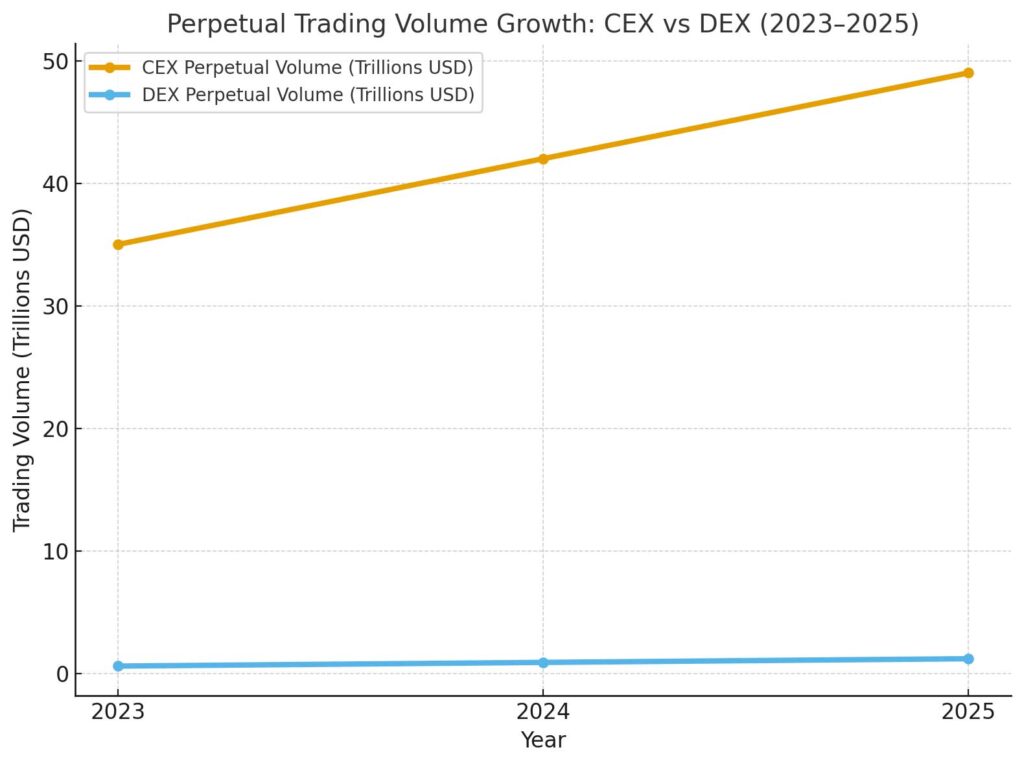
This migration signals that derivatives are becoming the foundation of onchain liquidity, not a speculative sideshow.
Lighter’s Vision: CEX Performance, DeFi Transparency
Lighter operates as both an Ethereum Layer 2 network and a decentralized perpetual exchange. Its design blends the speed of a centralized exchange with the trustless transparency of onchain settlement.
Key Features:
- ⚙️ Layer 2 Rollup Engine: Reduces gas fees, enables instant trade settlement, and supports scalability.
- 📈 High-Throughput Matching: Delivers CEX-grade execution speed while retaining onchain verifiability.
- 🔍 Proof of Trade: Each trade is recorded onchain, producing auditable transparency for regulators and institutional partners.
By removing intermediaries without compromising performance, Lighter addresses the two major hurdles that have long limited institutional DeFi adoption — latency and cost.
Why VCs Are Backing Perp DEXs
According to The Block’s data, onchain perpetual trading volumes reached an all-time high of $1.2 trillion in October 2025, driven by liquidations, incentive programs, and the exodus from CEXs facing regulatory pressure.
📊 [Chart Placeholder: “Total Onchain Perpetual Volume (2022–2025)”]
This surge is reshaping investor priorities. Instead of chasing airdrops or token incentives, venture firms are targeting protocols that prioritize execution, liquidity architecture, and risk management.
“This new generation of perp DEXs competes less on airdrops and more on infrastructure design,”
said Yogita Khatri of The Block.
Founders Fund and Ribbit Capital are betting that decentralized risk engines — like Lighter’s — will become the settlement backbone for institutional liquidity.
Decentralization Meets Institutional Demands
The collapse of major CEXs between 2022 and 2023 and the tightening of KYC and compliance regimes on Binance, OKX, and Bybit have accelerated a migration to non-custodial venues.
Lighter’s Layer 2 design, which integrates instant settlement and trade verification, is precisely the type of infrastructure sought by hedge funds, liquidity providers, and regulated digital asset desks that now require provable execution integrity.
By bridging onchain transparency with high-frequency performance, Lighter positions itself as a credible alternative to centralized clearing models, potentially redefining how institutional derivatives are cleared and settled.
The Road Ahead: Spot Markets and Token Launch
Lighter is not stopping at derivatives. Sources close to the company confirm plans to launch spot trading and expand liquidity pairs across major assets.
The funding round also included token warrants, granting investors early allocations of the upcoming Lighter Token (LGT).
While no official launch date has been announced, analysts anticipate a dual utility token that supports:
- Governance participation
- Trading fee discounts and staking rewards
- Cross-margin use cases across derivatives and spot markets
This integrated tokenomics model echoes dYdX’s V4 transition, but embedded directly at the Layer 2 infrastructure level — offering governance efficiency and capital fluidity not possible on traditional app-layer tokens.
The Bigger Picture: The Institutionalization of DeFi
Lighter’s entry into the $1B+ valuation club represents more than another bull-market headline — it marks the institutionalization of decentralized trading.
The leading players in this field — dYdX v4, Hyperliquid, Aevo, and now Lighter — are not competing on yield farming, but on throughput, transparency, and compliance readiness.
As DeFi matures, it is absorbing the lessons of traditional finance — risk control, speed, and liquidity depth — while retaining the programmable integrity that CEXs can’t match.
“Decentralized perpetual exchanges are becoming the invisible plumbing of digital markets — the clearing layers of the future.”
— Valerie, ConsortiumZ Market Intelligence
Conclusion: Performance-Grade Decentralization ArrivesAt a $1.5 billion valuation, Lighter represents a new class of DeFi infrastructure: decentralized yet performant, transparent yet institutionally robust.
As perpetual derivatives continue to dominate crypto liquidity — now driving three-quarters of total market activity — the success of Lighter may signal that DeFi’s infrastructure era has officially begun.
Key Takeaways
$68M Raise led by Founders Fund and Ribbit Capital at a $1.5B valuation
- Lighter operates as both an Ethereum Layer 2 and a decentralized perpetual exchange
- Perpetual DEXs now represent 56%+ of all onchain volume
- Institutional migration from CEXs accelerates demand for auditable execution
- Lighter plans to expand into spot trading and launch a native token (LGT)
© 2025 ConsortiumZ Market Intelligence
Research. Insight. Strategy.